

Anxiety isn't just "being stressed." It's the racing thoughts at 2 AM that won't shut off. The knot in your stomach before a work meeting. The tightness in your chest when the grocery store gets too crowded. Maybe you've tried meditation apps, breathing exercises, or just pushing through. And maybe those things helped for a little while, but the anxiety always comes back. Anxiety counselling in Red Deer at Patterson Counselling Services helps you understand where your anxiety actually comes from and gives you real strategies to manage it. If what you've been trying on your own hasn't been enough, that doesn't mean you're broken. It means you need a different approach.
When Anxiety Is Running Your Life
You might have been living with anxiety so long you've forgotten what calm actually feels like. Or maybe it came on suddenly and you can't figure out why. Either way, when anxiety starts interfering with your work, your relationships, your sleep, or your ability to just get through the day, it's time to talk to someone.
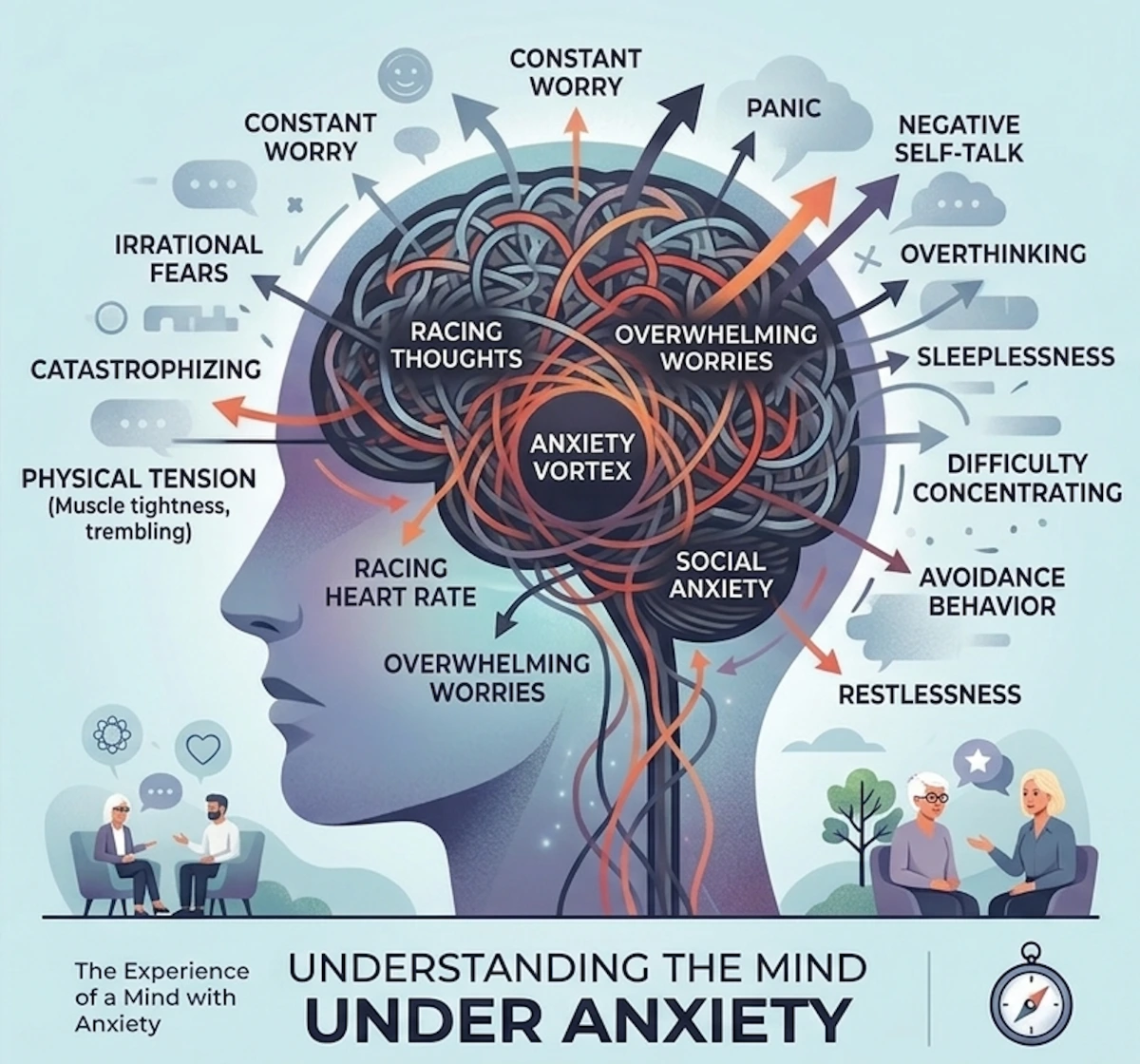
People who come to us describe their anxiety in different ways. Some feel a constant low-level dread that never fully lifts. Others experience sudden spikes of fear that seem to come out of nowhere. Some have both. The common thread is that their nervous system is stuck in overdrive and they can't turn it off on their own.
You might recognize some of these patterns: worrying about things that haven't happened yet, replaying conversations in your head looking for what you said wrong, avoiding situations because of how anxious they make you feel, trouble sleeping because your mind won't quiet down, or physical symptoms like headaches, stomach problems, muscle tension, or a racing heart that your doctor can't find a medical reason for.
The American Psychiatric Association notes that anxiety disorders affect nearly 30 percent of adults at some point in their lives, making them the most common category of mental health conditions. If you're nodding along, you're not imagining it and you're not being dramatic. Anxiety is your nervous system doing its job too aggressively. It learned to protect you at some point, and now it won't stand down.

When Anxiety Becomes Panic
For some people, anxiety doesn't just simmer in the background. It boils over into full-blown panic attacks. Your heart races, you can't catch your breath, your chest gets tight, and your body is screaming that something is horribly wrong. Some people end up in the emergency room the first time it happens because they're convinced they're having a heart attack.
A single panic attack is frightening on its own. But what often causes the most damage is what happens next: the fear of it happening again. That fear starts quietly and grows. You stop going to the grocery store because that's where it happened last time. You avoid the highway. You cancel plans because you can't guarantee you'll be okay. Your world gets smaller, and the avoidance becomes its own problem.
This pattern, where recurring panic attacks lead to ongoing fear and avoidance behaviour, is what clinicians call panic disorder. The DSM-5 classifies it under anxiety disorders, and that's exactly how we treat it: as part of the bigger picture of how anxiety is affecting your life. The National Institute of Mental Health describes panic disorder as involving recurrent and unexpected panic attacks, along with ongoing worry or behavioural changes due to the fear of future attacks. Treating the panic in isolation misses the point. The attacks themselves are intense, but the anxiety driving them is what needs to change.
Common panic symptoms include a racing or pounding heart, shortness of breath, chest tightness, dizziness, hot flashes or chills, tingling in your hands or face, and a feeling like you're losing control. These symptoms are terrifying in the moment, but they're your nervous system misfiring, not a sign that something is medically wrong.
If panic attacks have been shrinking your life, counselling can help you break that cycle. We address both the attacks themselves and the fear and avoidance patterns that build around them.
Why Your Anxiety Might Run Deeper Than You Think
Here's something that surprises many of our clients: the anxiety they've been battling for years often has roots that go further back than they realized. For a lot of people, persistent anxiety is connected to earlier life experiences, sometimes from childhood, that the nervous system never fully processed.
Research published in the National Library of Medicine shows that childhood trauma activates the body's biological stress response systems, and that this activation can persist into adulthood, leaving people in a state of chronic hypervigilance. Your brain learned early on that the world wasn't safe, and it never got the message that you can stand down now.
This doesn't mean you need to have experienced something dramatic. Growing up in a home where emotions were dismissed, where conflict was unpredictable, or where you learned to be invisible to stay safe can all shape how your nervous system responds to stress as an adult. The anxiety feels like it's about your job or your relationship or your health, but underneath, it may be an old alarm system that's still running.
Recognizing this connection often changes everything about how treatment works. Instead of just managing symptoms on the surface, we can address what's actually keeping your nervous system stuck.
How We Work With Anxiety and Panic
We don't hand you a worksheet on deep breathing and send you on your way. Anxiety counselling at Patterson Counselling Services starts with understanding your specific experience: when the anxiety or panic started, what triggers it, how it shows up in your body, what you've already tried, and what hasn't worked.
From there, we build a treatment plan that fits your situation. For some clients, that means learning practical skills for managing anxiety in real time, including understanding your body's stress signals and developing grounding techniques that actually work for you, not generic ones from the internet. For clients dealing with panic, we work on gradually reclaiming the activities and places you've been avoiding.
If unprocessed trauma or earlier experiences are fuelling your anxiety or panic responses, we may use Accelerated Resolution Therapy (ART). ART helps your brain reprocess the experiences keeping your nervous system stuck in alarm mode. It's evidence-based, works faster than traditional talk therapy for many people, and doesn't require you to relive painful experiences in detail. The Psychiatric Times reports that ART demonstrated strong clinical outcomes, with most clients needing fewer than five sessions.
Cognitive behavioural approaches also play a role. The APA recognizes CBT as a well-supported treatment for anxiety disorders, including panic, because it helps you identify and change the thought patterns and avoidance behaviours that keep anxiety in control.
Sessions are 50 minutes, typically weekly. Available in-person at our Red Deer office and online across Alberta.
Anxiety Counselling Fees in Red Deer
We discuss fees before your first appointment so there are no surprises. Treatment costs depend on session frequency and the length of your treatment plan.
Sessions with a Registered Psychologist are covered by most employer benefits plans. We accept Alberta Blue Cross, Manulife, Sun Life, Great-West Life, and other major insurance providers. If you're unsure about your coverage, contact us and we'll help you check.
Why Choose Patterson Counselling Services
Most people who come to us for anxiety have already tried other things. Maybe a previous counsellor gave you coping strategies that worked for a while but didn't stick. Maybe you've been on medication that took the edge off but didn't address the source. Maybe you've been white-knuckling it on your own because asking for help felt like admitting defeat.
What's different here is that we don't just treat the symptoms. Our Registered Psychologist, Cheryl Patterson, specializes in the connection between trauma and anxiety. If something deeper is driving your anxiety or panic, we'll find it and address it directly. You won't spend months circling around the problem without getting anywhere.
Our practice is women-owned, wheelchair accessible, and offers online sessions for clients who need privacy or flexibility. We serve clients from Red Deer, Lacombe, Sylvan Lake, Innisfail, Ponoka, Blackfalds, and communities across central Alberta.

Frequently Asked Questions About Anxiety Counselling
What's the difference between anxiety counselling and anxiety therapy?
Anxiety counselling and anxiety therapy overlap significantly. Counselling often focuses on building coping skills and managing current symptoms, while therapy (under our Psychologist services) tends to go deeper into root causes. At Patterson Counselling Services, we do both depending on what your situation needs. Many clients start with immediate relief strategies and then move into deeper work as they feel ready.
Can anxiety cause panic attacks?
Yes. Panic attacks are one of the ways anxiety can show up when it reaches a tipping point. Not everyone with anxiety experiences panic attacks, but if you do, it's a sign your nervous system is overwhelmed. We treat panic as part of the broader anxiety picture, not as a separate issue, because addressing the underlying anxiety is what stops the cycle.
I've tried breathing exercises and meditation but my anxiety keeps coming back. Will counselling be different?
Those tools can be helpful, but they only address the surface. Anxiety counselling at Patterson Counselling Services looks at what's driving the anxiety underneath, which is often rooted in past experiences your nervous system hasn't fully processed. When we address that, the anxiety often shifts in ways that coping techniques alone can't achieve.
Can anxiety be caused by childhood trauma?
Absolutely. Research consistently shows that early adverse experiences can sensitize the nervous system and increase vulnerability to anxiety disorders in adulthood. Many people with persistent anxiety discover it's connected to earlier life experiences they may not have considered traumatic at the time. Recognizing this connection often changes everything about how treatment works.
How long does anxiety counselling take?
It varies. Some clients notice meaningful improvement in 6 to 10 sessions. Others with deeper roots, especially those dealing with panic patterns or trauma-linked anxiety, benefit from longer-term work. We'll discuss a realistic plan during your first few sessions and adjust as things progress.
Can I do anxiety counselling online?
Yes. We offer secure video sessions for clients across Alberta. Online counselling works well for anxiety and gives you the flexibility to attend from wherever you feel most comfortable. Many clients prefer online sessions because it removes the stress of getting to an appointment when you're already feeling anxious.
What if I'm having panic attacks but I'm not sure if I have panic disorder?
You don't need a diagnosis before booking. Many people come to us knowing something is wrong but not sure what to call it. During your first sessions, we'll assess what's going on and build a treatment plan that fits your experience, whether that includes panic disorder or anxiety in another form.
Is panic disorder the same as having panic attacks?
Not exactly. A panic attack is a single episode. Panic disorder is when the attacks become recurring and the fear of having another one starts limiting what you do and where you go. Both respond well to treatment. If you're experiencing either, we can help.